Last Updated on by
Editor’s Note: This is a three-part article series for Trade Winds Imports written by Mike Bowman, a freelance writer and history enthusiast. It outlines the life and times of Thomas Crapper, famed “inventor” of the modern flush toilet. The views and opinions espoused by Mr. Bowman in this article do not necessarily represent the views of Trade Winds Imports.
Part 2
Thomas Crapper: The Legend
With a name like “Crapper,” how could he not have invented the toilet? It’s perfect.
Too perfect.
The universe may have a sense of humor, but sadly, in this instance, the joke is on us. “Sir John Crapper” never really existed. But Thomas Crapper, the plumber, did. And unfortunately, while he was a marketing genius and a brilliant plumber, even going so far as to become the official Royal Sanitary Engineer to British Royalty in the last decades of the 19th Century, he did not invent the modern flush toilet. He didn’t even patent the flushing device he is most often credited with, though he did have an impressive 9 patents to his name. For all of that juicy real-life backstory, you will have to check out our last article installment “Thomas Crapper: The Man.”

Thomas Crapper Toilet at the Victor Horta Museum, Brussels (Photo credit: Wikipedia)
Today’s installment is not about the truth; it’s not about who Thomas Crapper was. It’s about who Thomas Crapper became, years after his death. It’s about how this man, due to a combination of his own clever marketing and commitment to excellence (as well as a bit of sheer luck), became synonymous with the modern toilet, and was immortalized in myth as the man who invented the syphonic flushing W.C.
First of all: Thomas Crapper did NOT invent the flushing toilet. The flushing toilet is the byproduct of thousands of years of evolution, dating back to a simple flushing model found in the Indus Valley Civilization dating back to the 26th Century BCE [1]. But the modern toilet in its earliest form was most likely the one developed and patented by the London watchmaker Alexander Cummings in 1775 [2]. This is the first flush toilet patent we have on record. Cummings also developed the S-shaped water trap we still see today on many flush toilets, which is designed to trap odors [3].
Another major influencer of the modern toilet was Sir John Harington, 16th Century author and godson of the Queen. He concocted his idea for a simple flushing water closet in 1596, which he called the “Ajax,” and then implemented his design in Richmond Palace – home of the Queen herself. This early “flush” toilet deposited waste into a receptacle underneath the toilet and the flush valve. This receptacle needed to be manually emptied out every day [1].
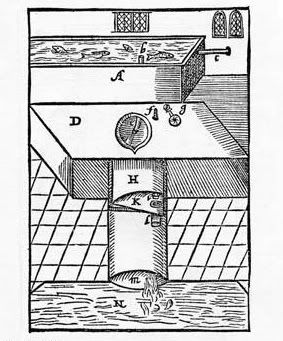
A diagram of the Harington flush toilet
OK, so Thomas Crapper did not invent the toilet. But he developed the syphon-flush system that we all know today, right? If you read our last post on Crapper, you know that isn’t true either. The patent for the “water-waste-preventing cistern syphon” was actually held by Albert Giblin, who was likely an employee of Crapper’s [5].
But what about this one? Thomas Crapper eventually became the Royal Sanitary Engineer for members of England’s elite, and became “Sir” Thomas Crapper before his retirement in 1904. This myth is only partially true. While indeed Thomas Crapper did become the Royal Sanitary Engineer, he was never knighted, and therefore he was never officially “Sir” Thomas Crapper [5]. Of course, the idea of a fearless, cavalier plumber with a cape and a valiant steed doing the heroic deeds necessary of a sensationalized knight in the service of royalty is a very fun one, and it is very deeply rooted in our culture and our sense of humor. Also, our video games like link w88:

Not pictured: Thomas Crapper.
Another prominent myth surrounding Thomas Crapper is the idea that our word “crap,” as a euphemism for feces, comes directly from his name – that he became so closely associated with toilets, our culture decided to bestow upon him the dubious honor of naming our most prominent toilet duty after him. This is simply not the case.
First of all, in all likelihood, Crapper’s last name was simply the Yorkshire way of saying “cropper,” a vocational last name, as is common among many European cultures [4]. But more importantly, the word “crap” had existed long before Thomas’ famous business. It dates back as far as the Latin terms “crappinum” meaning “chaff”, which then evolved to mean “waste products.” The word was also adopted to refer to waste (often agricultural) in Dutch (“krappe”), Low German (“krape” – meaning a vile and inedible fish), and Middle English (“crappe”) [5]. The earliest recorded instance of “crap” used as a verb literally meaning “to defecate” is pinned around 1846, after Thomas Crapper’s birth but certainly prior to his adulthood and career [9].
One myth that doesn’t seem to have been debunked – and therefore might very well be true – is that the distinctly American euphemism “crapper” (meaning “toilet bowl” or, more generally, the “restroom”) came from World War 1. American soldiers stationed in England supposedly noticed the name “Crapper” emblazoned on many of the local toilets and adopted the last name as a euphemism once they returned home. This does not seem especially farfetched as one of Thomas Crapper’s great marketing ideas was indeed to emblazon his name, without much subtlety, onto all of his products. One might easily imagine a U.S. doughboy informing his friends that he “needs to use the Crapper.” Indeed, the word “crapper” in reference to the restroom or toilet has its earliest sightings in print dating back to the 1930s, and it is a uniquely American slang term [2].
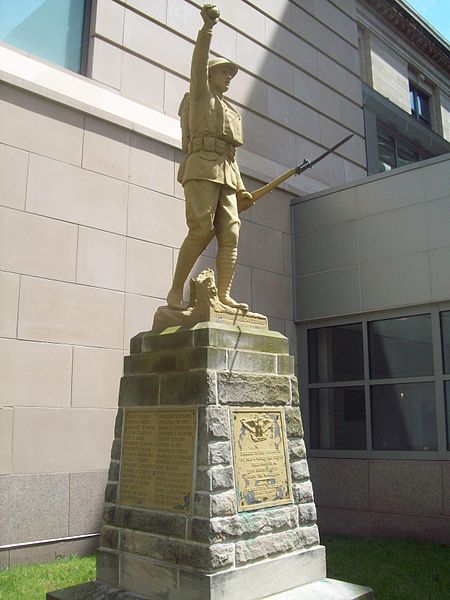
Private jokes become Major legends. These rank puns are poor quality in General.
There are obviously a great many myths surrounding this man, and much of it is just toilet humor. Why do we love these urban legends, then? Why do we believe in “Sir John Crapper” even though such a man never existed? Why do we forget who Thomas Crapper really was, in favor of this mythic idea?
Urban Legends, like those surrounding Thomas Crapper, the cliff-diving antics of suicidal lemmings, and Bigfoot, are stories designed to entertain, to frighten, to fill gaps in knowledge, and to connect ideas in a memorable way. Once these stories are constructed, they are disseminated throughout a culture by many means – usually by word of mouth at first, then by mass distribution in print or other media as the legend picks up notoriety.
Of course, unlike Bigfoot, the Thomas Crapper legend is much “stickier” in the sense that far more people believe it. It is sometimes cited as fact by even the most skeptical among us. Of course, the legend surrounding Thomas Crapper is fictional while remaining within the realm of plausibility, and grounded in an extremely feasible reality (“clever inventor with fitting name creates universal modern luxury that everyone takes for granted and has his name immortalized as a euphemism for poop,” as opposed to “hairy 8 foot tall humanoid with monstrously proportioned feet prowls around the Canadian wilderness and is almost never seen”). Crapper’s story is innately more believable simply because it requires less suspension of disbelief. And indeed, the man did verifiably exist… but there are many holes in his true story that curious people and enthusiastic tale-tellers felt a need to fill.
Since Thomas Crapper has so much mystery and so many “gaps” in his early life, biographically speaking, it is easy for people to talk about him – this famous businessman – as if they knew him, “before he got big” so to speak.
And the reason it’s said that he “invented the toilet” is likely in part a result of our very limited knowledge about toilet evolution. For something so mundane as a toilet, there is a lot of complicated history in it! To simplify such a long and intricate story, it is easier for us to attach the whole concept to one man.

Ancient Roman toilets. image courtesy of Wikimedia Commons.
In this case, “toilet” was attached to “Thomas Crapper,” for several highly plausible reasons: for one, Crapper was an astute businessman and a brilliant marketer, who was known for promoting and evangelizing his flush toilets in innovative ways that captured the public eye. Secondly, his name is delightfully coincidental – “crap” meant waste even before his birth, and literally meant defecation by the time he was a young boy, if not earlier. Urban legends are often used as mnemonics to help us remember things, and Thomas Crapper’s surname is instantly memorable. Thus, Crapper became synonymous with toilet in a figurative sense… and then indeed in a literal sense, when his last name was used by American soldiers to refer to toilets years after his death!
Over time, the man and the myth fused together into a legend that lies somewhere between truth and fiction, as all of the best urban legends do. Thomas Crapper was real, and he did wonderful things for the evolution and adoption of modern toilets. But he didn’t invent the toilet, he wasn’t knighted, and our euphemism for feces isn’t derived from his name, no matter how funny and culturally significant those myths all may be.
But this is one of the wonderful things about urban legends: how they can raise a man beyond his typical status, to exemplify his strengths, and transform him into a symbol of something extraordinary and entertaining. We might be surprised to hear that Thomas Crapper did not live up to his modern reputation, perhaps, but we are likely more than happy that such a fun urban legend exists. And when you are using one of today’s incredibly sophisticated toilets, please think about Thomas Crapper and the things he has done for us – for his innovations and his enthusiastic promotion of a product that has become so integral to our lives.
Sources:
[1] http://en.wikipedia.org/wiki/Flush_toilet
[2] http://www.snopes.com/business/names/crapper.asp
[3] http://news.discovery.com/tech/who-invented-the-toilet.html
[4] http://www.exnet.com/1995/11/01/science/science.html
[5] http://www.theplumber.com/crapper.html
[6] http://urbanlegends.about.com/od/factoid1/p/thomas_crapper.htm
[7] http://www.wisegeek.com/who-is-thomas-crapper.htm
[8] http://www.thomas-crapper.com/did-you-know.asp
[9] http://www.etymonline.com/index.php?allowed_in_frame=0&search=crap&searchmode=none
Related articles

Mike is the acting Digital Content Manager at Trade Winds Imports. He has been writing about home improvement, remodeling, and design for over 9 years and has been featured in such publications as theSpruce, ApartmentTherapy, Freshome, Huffington Post, and Forbes. When he’s not busy writing, developing websites, or working on his own house, he’s spending time outside with his wife, 2 year old daughter, and newborn son. If you have any questions or comments regarding the content on this site, please email Mike!